EU AI Act India compliance Starts Today: What Indian IT, SaaS and Enterprise Leaders Must Do
August 2, 2026 activates the EU AI Act’s penalty regime. Here is what it means for every Indian organisation that builds, deploys or processes AI for the European market.
EU AI Act India compliance
The Date Most Indian Leaders Missed
For the past several months, the dominant narrative on the EU AI Act has been relief. The Digital Omnibus deal of May 7, 2026 — signed into EU law on July 8, 2026 — postponed the most demanding obligations for high-risk AI systems from August 2, 2026 to December 2, 2027. For European enterprises still building their compliance infrastructure, this was a significant reprieve.
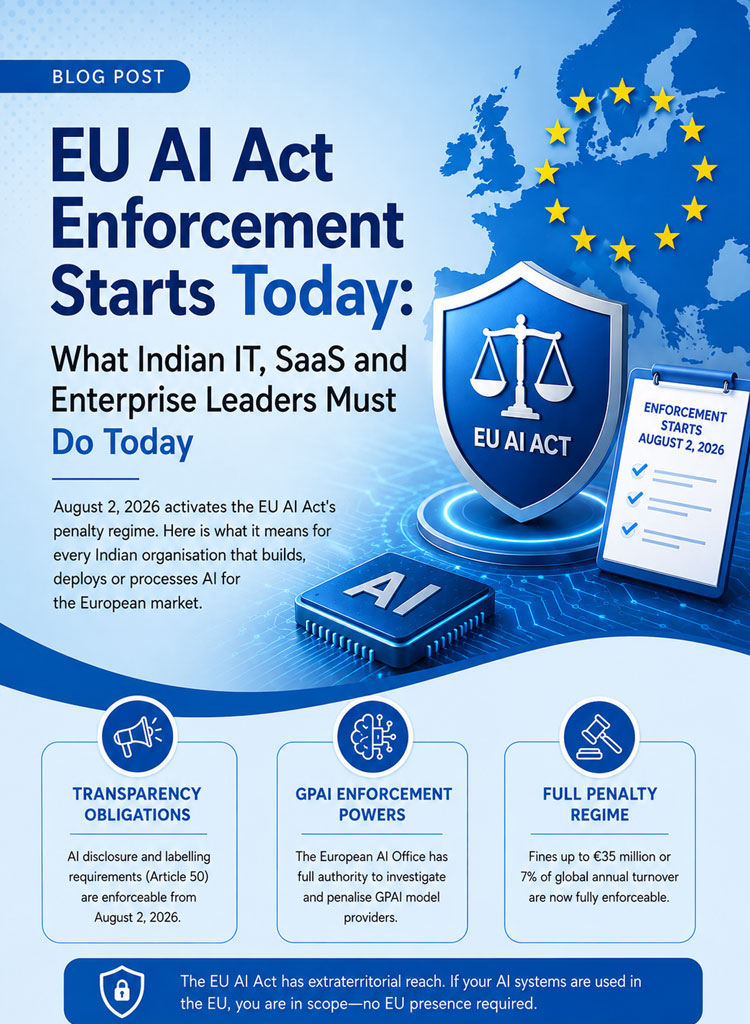
That reprieve does not mean August 2, 2026 is a quiet date. It means precisely the opposite. Today is when the EU AI Act’s enforcement regime goes fully operational. Three obligations become enforceable on August 2 regardless of the Omnibus extension:
- Article 50 Transparency: Any organisation deploying a chatbot, AI-generated content tool, or synthetic media system must clearly disclose to users that they are interacting with AI. AI-generated content must carry machine-readable labels. This applies to every organisation with EU-facing digital products and services.
- GPAI Enforcement Powers: The European AI Office now holds full authority to investigate and penalise general-purpose AI model providers. If your organisation provides or fine-tunes foundation models for EU clients, enforcement is live.
- The Full Penalty Regime: Fines of up to EUR 35 million or 7% of global annual turnover — whichever is higher — are now enforceable. This exceeds GDPR’s maximum. Regulators have stated they will prioritise high-profile and systemic violations first, but enforcement infrastructure is operational.
For Indian IT firms, SaaS companies, BPOs, and any enterprise that builds AI-powered products for European clients, this is not a European compliance problem. The EU AI Act’s extraterritorial reach mirrors the GDPR. Article 2(1)(c) of the regulation captures any provider or deployer established in a third country whose AI system’s output is used within the European Union. If an Indian software firm delivers an AI system to a Dutch client, that system is in scope. If an Indian SaaS product is used by EU-based subscribers, it is in scope. Physical presence in Europe is not required.
Being GDPR-Compliant Does Not Make You EU AI Act-Compliant
This is the most consequential misconception facing Indian enterprise compliance teams right now. For nearly a decade, Indian IT firms and data-processing organisations have built GDPR compliance programs, appointed DPOs, implemented SCCs for data transfers, and invested in privacy infrastructure. None of that work covers the EU AI Act’s distinct requirements.
GDPR governs how you process personal data. The EU AI Act governs how you build, deploy, and use AI systems — with additional obligations that have no GDPR equivalent:
- Transparency Disclosure (Article 50): GDPR has no equivalent requirement to label AI-generated content or disclose AI interaction.
- AI System Classification: The EU AI Act requires every organisation to classify its AI systems by risk tier. GDPR has no system classification requirement.
- GPAI Provider Obligations: If your organisation provides or fine-tunes a general-purpose AI model, you carry obligations — technical documentation, copyright compliance policies, model evaluation results — that are entirely outside the GDPR framework.
- Deployer Human Oversight: Organisations deploying high-risk AI systems must assign trained, competent, authorised individuals to oversee those systems. GDPR does not require this.
At AnantaQuanta Consulting, we regularly conduct compliance assessments for Indian IT organisations that confidently describe themselves as GDPR-compliant — and discover they have not yet mapped a single AI system under the EU AI Act framework. The gap is structural, not accidental, because GDPR and the AI Act were built for different problems.
Shadow AI Is Your Most Immediate EU AI Act Liability
Before addressing the formal compliance program, every Indian organisation must confront a more immediate problem: shadow AI. Research from 2026 puts the scale in stark relief. Between 65% and 80% of employees are using unapproved AI tools in their daily work. Only 37% of organisations have formal AI governance policies in place. The most common categories of sensitive data employees are feeding into unapproved tools include source code (30% of inputs), legal work product (22.3%), and merger and acquisition data (12.6%).
For Indian IT and SaaS firms, this is not merely an internal governance concern. When employees use personal ChatGPT, Claude, or Gemini accounts to process EU client data — code for a European banking system, support tickets containing EU customer records, contract summaries from EU deals — that usage simultaneously triggers GDPR obligations (data transferred to a US processor without adequate mechanism) and EU AI Act obligations (AI system deployed on EU-market work without governance). The average data breach associated with shadow AI costs USD 4.63 million. The reputational and contractual damage to client relationships compounds that.
The answer is not a blanket ban. Research shows blanket bans push usage to personal devices where it becomes invisible. The solution is a governed AI environment: approved tools with enterprise data controls, a clear AI acceptable-use policy, employee training, and monitoring capability.
What Indian Organisations Should Do Right Now
Given the enforcement date is August 2, the immediate priority is risk triage, not perfection. AnantaQuanta Consulting recommends the following sequence for Indian organisations with EU market exposure:
- Identify your EU-facing AI systems — every chatbot, AI-powered product feature, analytics output, or generative AI tool used by or for EU clients. Article 50 disclosure requirements apply to these from today.
- Add AI disclosure to your EU-facing products where missing — this is the single highest-priority compliance action for August 2. A clear disclosure that users are interacting with AI, and that AI-generated content is labelled as such, can be implemented quickly.
- Audit for shadow AI usage — identify every unapproved AI tool in use across your organisation, particularly on EU client work. This requires network-level visibility, not a survey.
- Map your AI systems to EU AI Act risk tiers — the risk classification determines the scope of your compliance obligations for the December 2027 deadlines. Starting this now creates the governance foundation.
- Review your EU data transfer mechanisms — SCCs are mandatory for India-to-EU data transfers. If those transfers involve AI systems, both GDPR and the EU AI Act apply concurrently. Your DPA and SCCs may need AI Act addenda.
The Compliance Advantage
Organisations that treat the EU AI Act as a European problem will face scrambled remediation in 2027. Those that build structured compliance programs now — combining EU AI Act mapping, GDPR integration, shadow AI governance, and DPDP alignment for their India operations — will hold a meaningful competitive advantage. European enterprise buyers are already beginning to include EU AI Act compliance as a criterion in vendor selection. Indian IT and SaaS firms that can demonstrate structured AI governance will win deals that their less-prepared competitors will lose.
Conclusion
August 2, 2026 is not the dramatic enforcement date the AI Act countdown suggested. The high-risk deadlines were pushed back. But the penalty regime, the transparency obligations, and the GPAI enforcement powers are live from today — and every Indian organisation with EU market exposure is in scope.
GDPR compliance was the compliance challenge of the last decade for Indian IT firms. EU AI Act compliance is the challenge of the next three years. The organisations that begin now, with structured programs that integrate EU AI Act, GDPR, and DPDP obligations, will spend a fraction of what the late movers will pay.
AnantaQuanta Consulting helps Indian IT firms, SaaS companies, and enterprises build practical EU AI Act compliance programs that integrate with their existing GDPR and DPDP obligations. We offer EU AI Act readiness assessments, shadow AI governance frameworks, and multi-regulatory compliance roadmaps tailored to Indian organisations with EU market exposure.
Contact Us
Request an EU AI Act Readiness Assessment for Your India Operations A structured review of your EU-facing AI systems, Shadow AI exposure, and Article 50 compliance posture — delivered as a board-ready gap report with a prioritised remediation roadmap. Contact AnantaQuanta