Why Indian Enterprises Must Act Now: AI Governance as Your Shield Against DPDP
The Digital Personal Data Protection (DPDP) Rules were notified on November 13, 2025, converting years of draft legislation into enforceable law, with full compliance mandatory by May 13, 2027. Most enterprise DPDP programs are being built around consent notices, data mapping, and breach protocols — and quietly leaving out the one system category most likely to trigger a violation: AI. Every AI deployment that touches personal data is a data processing activity under the Act, whether or not anyone labeled it that way.
Table of Contents
AI Governance Is a Board-Level Risk, Not an IT Checkbox
Under Section 8(1) of the DPDP Act, a Data Fiduciary remains accountable for compliance regardless of who — or what — actually processes the data. Outsourcing inference to a third-party model doesn’t outsource liability. That single principle is why AI governance can’t sit inside an engineering backlog: the organization, not the AI vendor, is the party a regulator will hold responsible.
Where Standard AI Practice Collides With DPDP Principles
Purpose limitation vs. broad-purpose training. A customer who consents to account opening hasn’t consented to their data shaping a credit-scoring or churn-prediction model. Feeding operational data into general-purpose AI pipelines without a matching, disclosed purpose is a direct purpose-limitation problem, not a theoretical one.
The anonymization myth. The DPDP Act doesn’t prescribe a technical standard for anonymization, and legal commentary is consistent on one point: pseudonymized data — names swapped for tokens, with the mapping kept elsewhere — remains personal data, because re-identification stays possible. True, irreversible anonymization is a high bar that most “de-identified” AI training sets don’t actually clear.
The automated decision-making gap. Unlike the GDPR’s Article 22, the DPDP Act has no explicit right against purely automated decisions. Legal scholars widely flag this as a genuine regulatory gap, not a settled protection — with one exception: Significant Data Fiduciaries must already assess algorithmic fairness through mandatory DPIAs and independent audits under Rule 13. For every other organization, the absence of an explicit rule today is not a safe harbor; it’s a gap regulators and courts are actively expected to close.
The Third-Party AI Vendor Exposure
Section 16 of the DPDP Act takes a “negative list” approach to cross-border transfers: data may move to any country by default, unless the Central Government specifically restricts that destination — and as of today, no country has been restricted. That’s more permissive than many teams assume, but it doesn’t remove the real exposure. The risk isn’t geography; it’s contract terms. Standard consumer or enterprise terms of service from global AI providers weren’t written for DPDP’s specific requirements around purpose limitation, breach notification timelines, or consent-withdrawal cascades — and sectoral regulators like the RBI can still impose stricter localization rules independent of DPDP. Accountability under Section 8(1) stays with you either way.
Shadow AI: The Governance Gap Nobody Owns
Employees pasting customer records into unsanctioned generative AI tools aren’t acting maliciously — they’re trying to work faster. But every one of those interactions is personal data processing your organization didn’t authorize, can’t audit, and would struggle to defend in a regulatory inquiry. Shadow AI is where most enterprises’ actual DPDP exposure lives today, well ahead of any formal AI system they’ve reviewed.
Building the AI Governance Framework
- Stand up an AI Governance Council — CISO, CDO, Legal, and AI engineering — that vets every AI use case against DPDP principles before development starts, not after deployment.
- Complete an AI data inventory: where personal data enters ML pipelines, what consent basis covers it, and which jurisdictions process it.
- Replace vendor boilerplate with DPDP-calibrated Data Processing Agreements — explicit no-training-on-your-data clauses, purpose limitation, and breach notification SLAs.
- Build human-in-the-loop review for any AI-driven decision with material consequences for a data principal, ahead of regulatory clarity rather than after an enforcement action forces it.
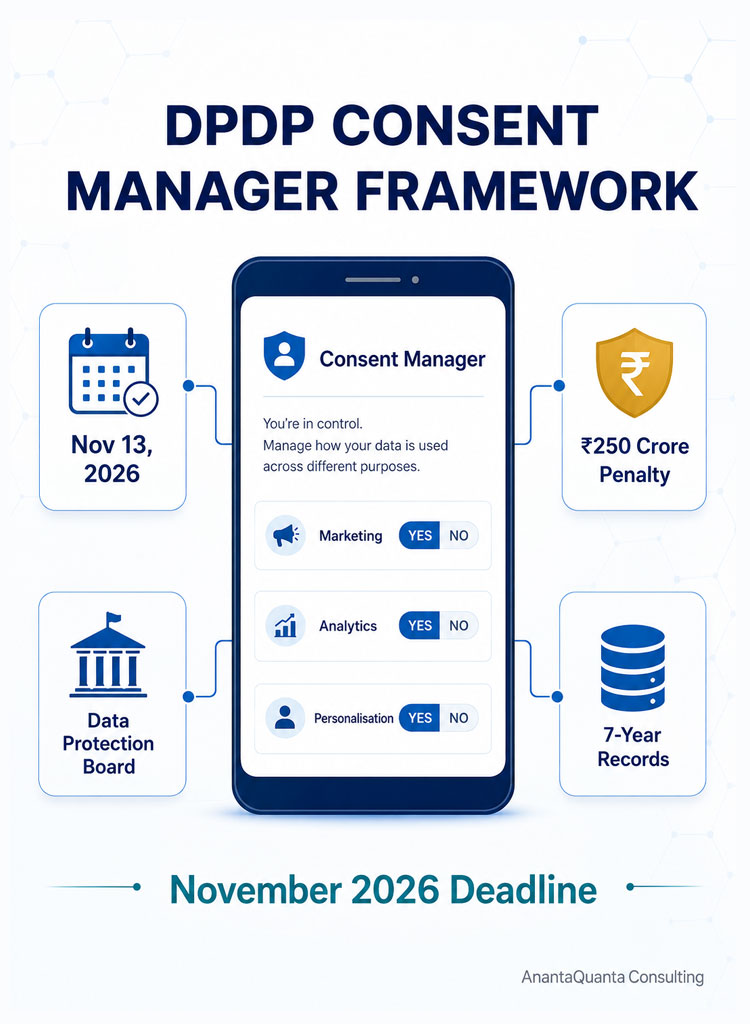
- Prepare consent infrastructure for the Consent Manager framework opening in November 2026, so consent withdrawal automatically pauses downstream AI processing.
Common Implementation Mistakes
- Reading “no restricted-country list yet” as “no cross-border risk” — the contractual and accountability exposure exists regardless.
- Assuming pseudonymization exempts a dataset from DPDP obligations.
- Running AI governance and DPDP compliance as two separate workstreams instead of one.
Conclusion
The gap between “we have an AI policy” and “our AI systems are DPDP-compliant” is where most enterprise risk currently sits. Organizations that close it now — before formal enforcement scales up through 2026 and into the May 2027 deadline — turn AI governance from a liability into a genuine differentiator with regulators, customers, and boards alike.
Ready to find out where your AI systems actually stand against DPDP?
Ananta Quanta Consulting offers a structured AI-DPDP exposure assessment for CISOs and privacy leaders building governance ahead of the deadline.